
How Distributors Can Find the Right Solutions in the Age of AI
Growing up, I remember that whenever my mother bought a new car, she took my uncle with her. It was not because she lacked the knowledge or ability to make the decision. She was a chemist, understood how engines worked, and was perfectly capable of evaluating her options.
She was also wise enough to recognize the value of an unbiased perspective.
A good salesperson can help you understand a vehicle, but the salesperson is still trying to sell you one. My uncle’s only concern was helping my mother choose the right car for her circumstances. For a major purchase, having someone she could trust provided tremendous value.
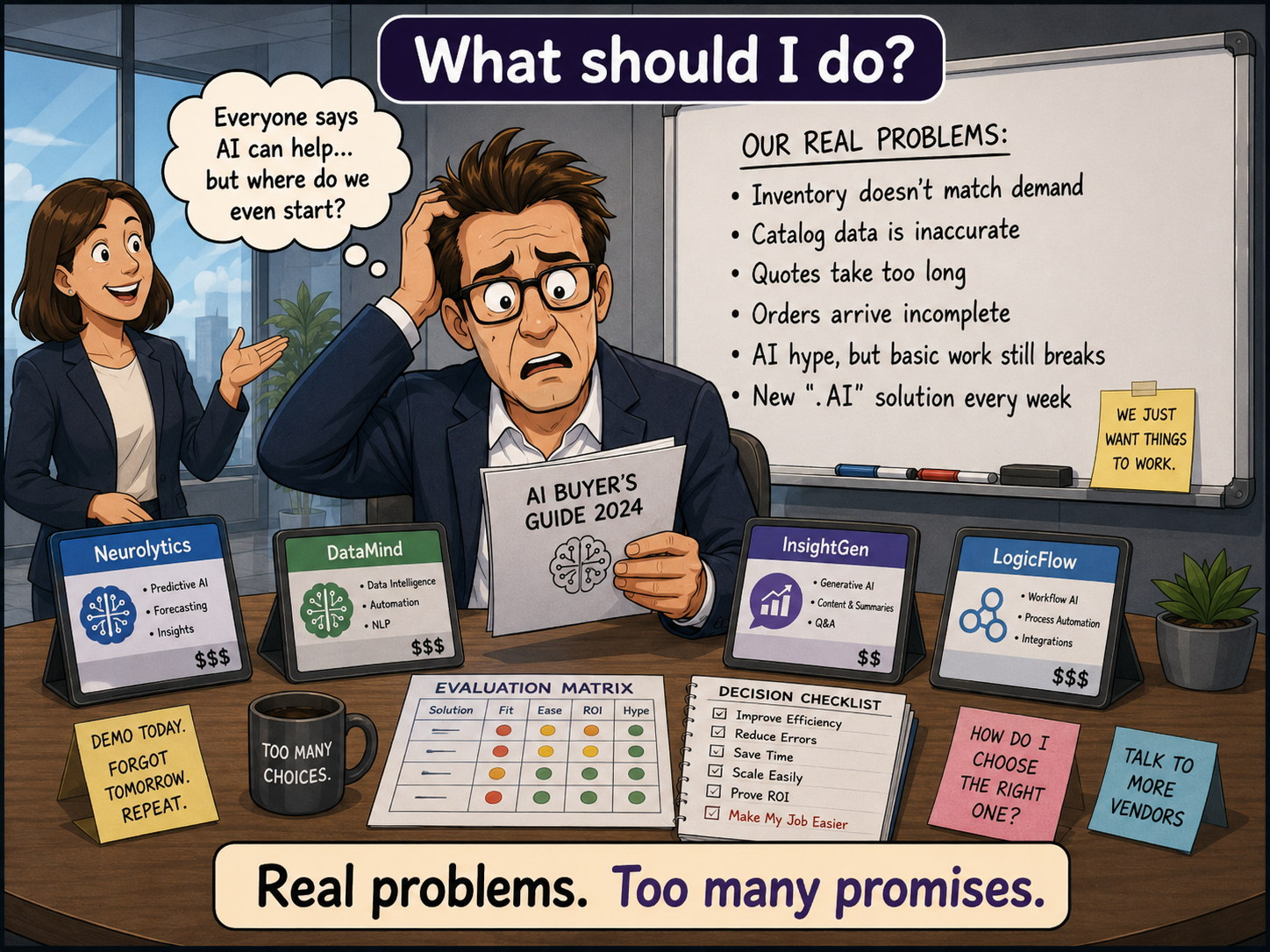
Distributors face a similar challenge today, starting with piles of operational challenges, all of them leading to numerous choices to be made:
Inventory does not match customer demand, leaving capital tied up in products that are not moving while customers go elsewhere for products that are out of stock.
Supplier products are not represented accurately or consistently in the catalog, making it difficult for customers and salespeople to find the right items.
Salespeople spend too much time creating basic quotes instead of selling.
Fulfillment teams receive incomplete or poorly structured orders and must resolve the problems with already-frustrated customers.
You keep hearing that AI will transform the business, yet you still struggle to find someone to move a pallet from the truck to the correct warehouse row.
There seems to be something with a “dot AI” name released each week, promising to solve everything, but you don't know where to begin even finding the right solution let alone implementing it.
Uncertainty is stressful. And numerous options and noise creates the stressful "curse of choice."
Buying a car creates the same problem. The right vehicle depends on what you actually need it to do. Do you need to haul stone on the weekends or a car full of children to sporting events? Are you driving 100 miles a day or 10? Do you need safety features for a teenager or are you just looking for a muscle car to get you to the club?
There is no universally correct vehicle. There is only the right vehicle for your circumstances.
First, define the outcomes you need based on your highest-priority pain points. You cannot solve everything at once, so you must identify what matters most now.
Next, understand how work flows through the organization around those pain points. Technology may be part of the answer, but the real gap could also be procedural, organizational, or related to unclear roles and information.
Then, determine what changes will create the greatest value. That may involve new technology, better use of existing systems, redesigned processes, or some combination of the three.
Finally, create a practical strategy for helping the organization adopt the change. A solution that employees do not understand, trust, or use leaves most of its potential value on the table.
Like my mother bringing someone she trusted into the car-buying process, mature leaders seek partners who can help them evaluate their circumstances, prioritize their needs, and provide an unbiased point of view. In some cases, that partner helps navigate the entire transformation. In others, simply developing a clear strategy is enough to align the organization and get everyone swimming in the same direction.
We have worked with complex distributors of all sizes and can help you build a strategy that's right for your organization today. Because we want to you do more with technology. More importantly, we want you to spend less time dealing with preventable problems, operational fires, and avoidable rework.
We want to get your Friday's back. Want to learn more?