
For years, the digital playbook for local and mid-market businesses centered on search. Optimize for Google. Rank for the right keywords. Appear when someone types “pizza near me” or “industrial fastener supplier.” That model still matters. Yet a growing share of people no longer start with a traditional search engine. They start with a conversation.
They open Grok, ChatGPT, Claude, Gemini, or another AI interface and simply ask a question. They expect a back-and-forth conversation, often speaking as they drive or move about their day. They do not want a list of blue links. They want an answer, a recommendation, and—increasingly—an action completed without leaving the chat. This shift is already measurable. Adobe Analytics has tracked explosive growth in AI-sourced traffic to U.S. retail sites, including 693% year-over-year increases during the 2025 holiday season and continued triple-digit gains into 2026. Consumer surveys show roughly 43% of U.S. online shoppers used AI for product research in a recent 90-day window, with majorities planning to use AI chatbots for shopping more frequently.
When customers turn to AI first, visibility alone is no longer sufficient. The business that can be recommended and acted upon wins the interaction. The business that cannot do this is skipped and made irrelevant.
From Recommendation to Transaction
Consider a simple request: “Find me the closest pizza place.” An AI can surface the local shop through indexed data and location signals. But the next sentence changes the economics: “Order me a large pepperoni pizza for pickup in 30 minutes.”
National chains can often complete that type of request today. They have the engineering resources to maintain real-time inventory, ordering APIs, and direct integrations with major AI platforms. The independent shop on Main Street typically cannot. The same pattern appears in B2B. A manufacturer that supplies a widget may still be discoverable, yet the factory’s systems cannot place an order automatically. The buyer’s AI falls back to email, phone, or a human-operated portal—extra friction that larger, agent-ready suppliers do not impose.
Agentic commerce—AI systems that move from discovery through decision to transaction—is scaling rapidly among organizations that can afford the infrastructure. McKinsey estimates that by 2030 agentic commerce could orchestrate up to $1 trillion in U.S. B2C retail revenue and $3 trillion to $5 trillion globally. Bain projects the U.S. agentic commerce market at $300–500 billion by the same year, representing 15–25% of e-commerce. Other forecasts from Morgan Stanley and J.P. Morgan place agent-driven or agent-influenced share in the 10–25% range of U.S. online sales. These are not distant possibilities; the traffic and behavioral data already show the front end of the shift.
What the Numbers Mean for Local and Mid-Market Businesses
When a meaningful and growing portion of discovery and purchasing migrates into AI conversations, the competitive question becomes practical: whose catalog, availability, and ordering capability does the agent see and trust?
Businesses that remain only partially visible—or worse, non-actionable—create friction. Their competitors that are fully connected are instead greasing the rails. Over time, that difference compounds. Customers and procurement agents route more volume to the easier path. Relationships and reorder data follow the transactions. Local retailers, professional services firms, specialty manufacturers, and Main Street operators that delay readiness effectively concede share of a market projected to reach hundreds of billions in the United States alone within a few years. Forty percent of small businesses have already reported traffic disruption linked to AI search changes; the transaction layer represents the next and larger step.
The opportunity cost is therefore not abstract. It is the revenue, customer lifetime value, and competitive position that flow to whoever makes it simpler for an AI agent—and by extension the human behind it—to complete the business.
Closing the Gap: The Common Connector
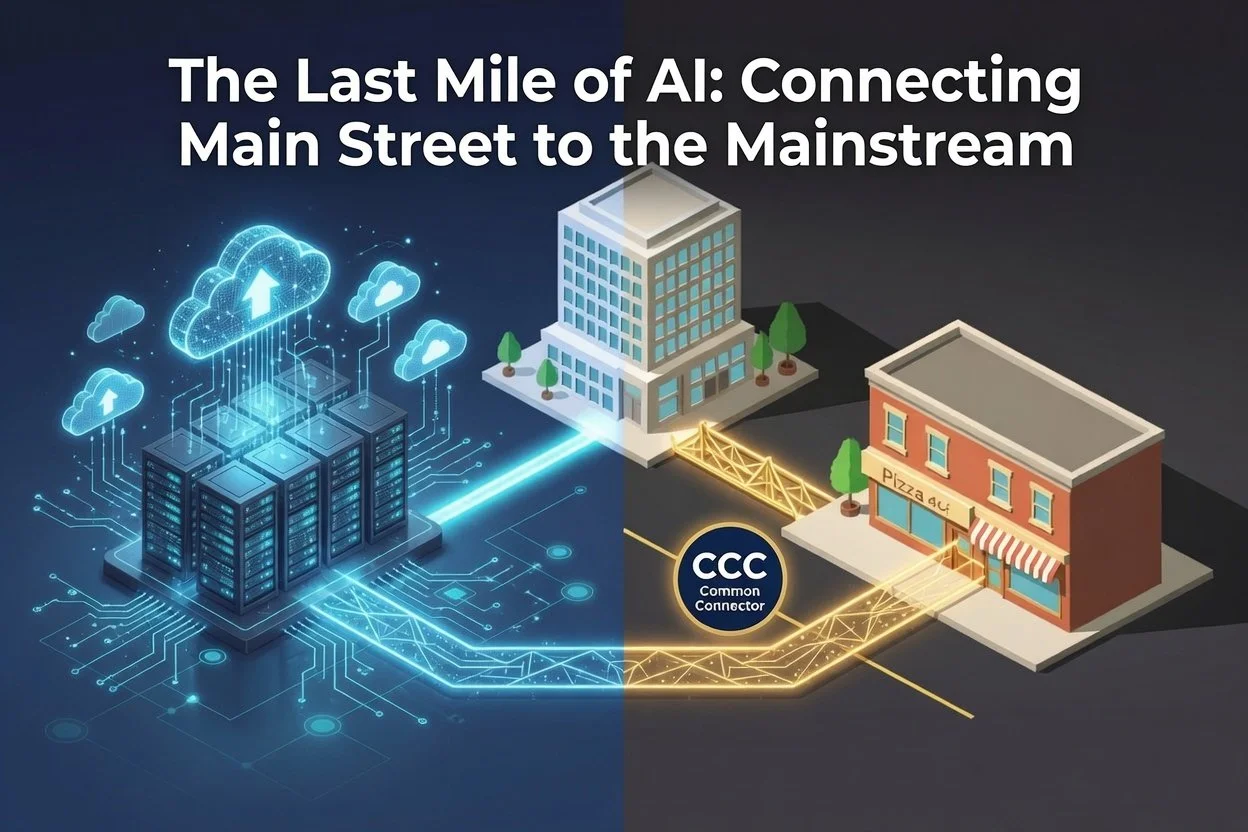
Common Consulting Company has built a practical answer for Main Street: the Common Connector.
The Common Connector functions as a managed plugin layer that AI platforms can use the same way they already connect to productivity tools such as email, calendars, or messaging systems. Through it, a local business can expose products, services, availability, and ordering capabilities in a standardized, secure format without standing up its own development team or maintaining complex APIs.
Rather than requiring every independent pizzeria or mid-sized manufacturer to become a technology company, the Common Connector rides the existing fabric of local economic development. We partner with chambers of commerce, Main Street organizations, and similar community institutions. These partners already understand their members’ operations and serve as trusted intermediaries. Through that channel, businesses gain the ability to participate in AI-mediated discovery and transaction without the infrastructure burden that would otherwise exclude them.
The model works for consumer-facing businesses and for B2B supply chains alike. A factory’s autonomous agents can query available inventory and place replenishment orders. A resident can ask an AI to arrange a service appointment or complete a purchase from a neighborhood merchant. In both cases, the Common Connector provides the clean hand-off that turns conversation into commerce.
What Comes Next
The move from search-centric to AI-centric interaction is visible in current traffic data, consumer surveys, and the product roadmaps of major platforms. Organizations that treat AI solely as another marketing channel will remain discoverable but not fully actionable. Those that close the last mile keep the path of least resistance aligned with their own offerings.
Common Consulting Company has solved the technical and operational challenge of making that last mile accessible to the businesses that form the backbone of communities and supply chains. We are scaling the Common Connector through partnerships that keep the solution practical, trusted, and grounded where commerce actually happens.
The practical question for local and mid-market leaders is straightforward: when a customer or a partner’s AI agent is ready to transact, will it be easier to do business with you—or with someone else?
Key Sources
Adobe Analytics / Adobe Digital Insights reports on generative AI and AI-referred traffic to U.S. retail sites (2025–2026), including holiday 2025 (+693% YoY) and Q1 2026 growth figures.
McKinsey & Company research on the agentic commerce opportunity, projecting up to $1 trillion in U.S. B2C retail revenue and $3–5 trillion globally by 2030.
Bain & Company 2030 forecast: U.S. agentic commerce market of $300–500 billion (15–25% of e-commerce).
Supporting market share and adoption estimates from Morgan Stanley and J.P. Morgan (agent-driven or agent-influenced share of U.S. online sales in the 10–25% range by 2030).
Consumer research indicating approximately 43% of U.S. online shoppers used AI for product research in a recent 90-day period, with elevated intent to use AI chatbots for shopping.
Industry observations on small-business traffic disruption linked to AI search changes (approximately 40% of small businesses reporting impact).