
Predicting the Next Renovation Hot Spot in Your Service Area
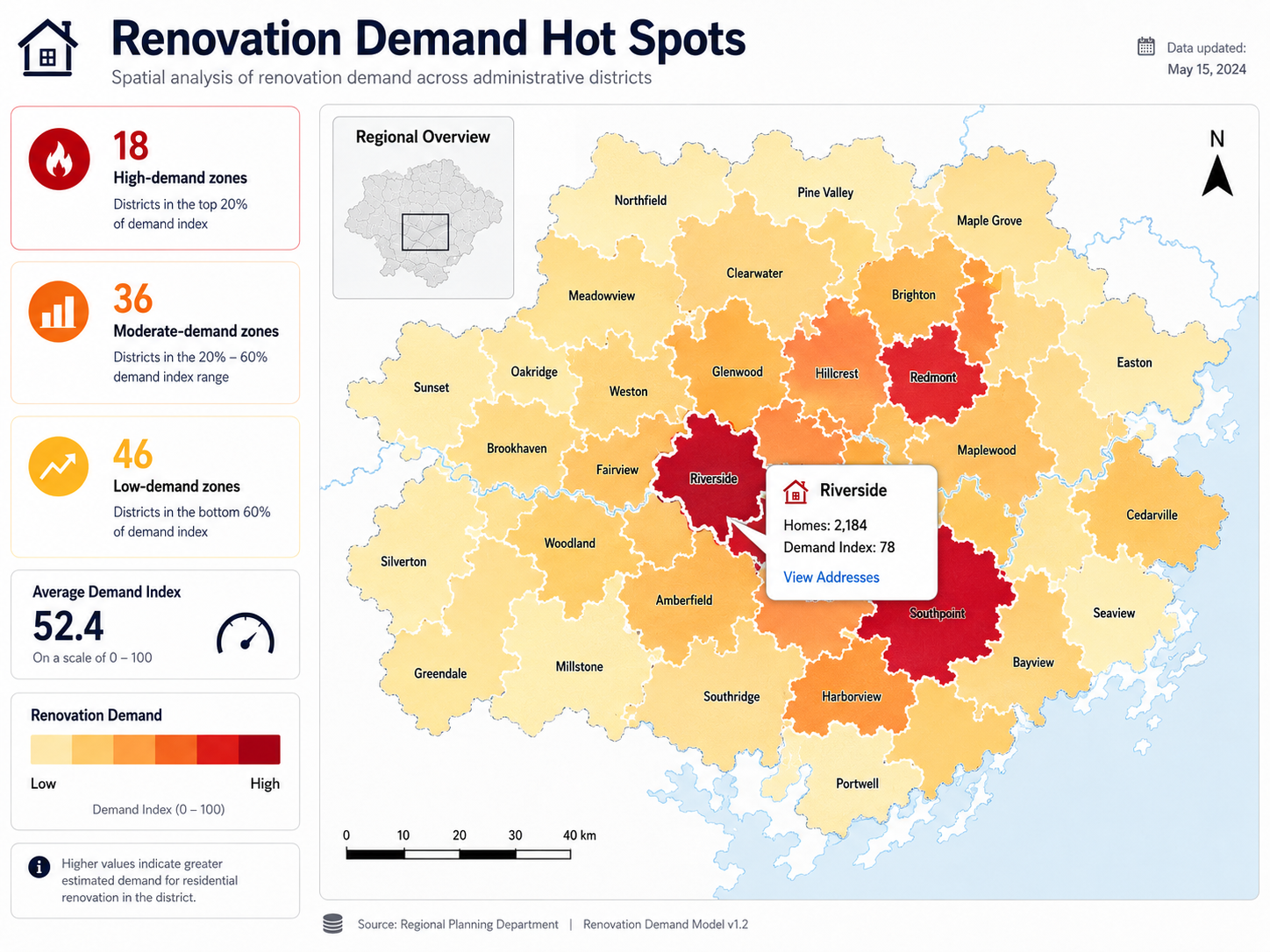
Most contractors think renovation demand is something they have to wait for.
A homeowner decides to remodel a kitchen, replace a roof, finish a basement, or update an aging property. They search online, ask a neighbor, or contact a contractor they already know. The contractor then competes for the opportunity after the buying process has already begun.
But what if you could identify the neighborhoods where renovation demand was likely to increase before the phone started ringing?
That may be more possible than most contractors realize.
Renovation Demand Is Not Random
Renovation activity tends to concentrate in certain geographic areas.
Some neighborhoods have aging homes that are reaching a major replacement cycle. Others are experiencing increased property sales, rising home values, changing demographics, or an influx of new owners who want to update recently purchased homes.
A community with older housing, financially capable homeowners, increasing property turnover, and visible investment activity may be more likely to generate renovation work than an area without those conditions.
These patterns can be identified.
The objective is not to predict the exact homeowner who will renovate a bathroom next month. It is to identify the geographic areas where the conditions for renovation demand are beginning to align.
For a contractor that could mean identifying specific communities, neighborhoods, or service areas that are more likely to produce opportunities over the next six to eighteen months.
Why Contractors Should Care
Most contractors have limited sales and marketing resources.
You cannot send crews everywhere. You cannot build relationships in every municipality. You cannot advertise equally across every ZIP code. You cannot spend the same amount of time developing referral partners in every community.
Without a clearer view of the market, contractors often rely on familiar territory, word of mouth, intuition, or broad advertising campaigns.
Those approaches can work, but they can also lead to wasted effort.
A renovation hot-spot model helps answer a more useful question:
Where should we focus our attention before everyone else does?
That information can influence how you market, sell, hire, schedule, and grow.
Focus Your Marketing Where Demand Is More Likely
Instead of treating every neighborhood equally, you could prioritize the areas that appear to have the strongest combination of aging homes, homeowner purchasing capacity, recent property turnover, and increasing investment.
That could improve how you use:
Direct mail
Local search advertising
Social media campaigns
Yard signs
Door hangers
Community sponsorships
Home shows and local events
Referral partnerships
Neighborhood-specific landing pages
The goal is not necessarily to spend more. It is to spend more deliberately.
Develop Better Referral Relationships
A strong renovation market involves more than homeowners and contractors.
Real estate agents, property managers, designers, architects, lenders, insurance professionals, home inspectors, suppliers, and municipal officials may all see early signs of changing activity.
When you know which areas you want to grow in, you can build referral relationships more strategically.
You might develop relationships with:
Real estate agents selling older homes
Home inspectors serving high-turnover neighborhoods
Designers working with recent buyers
Property managers overseeing aging rentals
Suppliers serving active remodeling markets
Lenders offering renovation or home-equity financing
Instead of networking broadly, you can build connections around specific geographic opportunities.
Make Smarter Hiring and Capacity Decisions
Growing contractors face a difficult question:
Is the increase in work sustainable enough to justify hiring?
A sudden surge in projects does not always mean the market is expanding. It may be seasonal, referral-driven, or temporary.
A geographic demand model provides another perspective. If several nearby communities are showing sustained signs of renovation activity, the contractor may have stronger evidence that additional estimating, sales, project management, or field capacity will be needed.
Decide Which Services to Promote
Not every neighborhood needs the same type of work.
An area with homes built several decades ago may create demand for roofing, windows, electrical upgrades, HVAC replacements, kitchens, bathrooms, siding, and structural repairs.
A neighborhood experiencing frequent property sales may generate more cosmetic renovations, additions, flooring, painting, and projects designed to help new owners personalize their homes.
Areas with rising property values may support larger projects because homeowners are more confident that improvements will contribute to the long-term value of the property.
Understanding where demand may be forming can help a contractor decide not only where to market, but also which services to promote.
Get Ahead of the Competition
Most contractors respond to demand after it becomes obvious.
Once a neighborhood is filled with dumpsters, contractor signs, renovation permits, and newly updated homes, everyone can see the opportunity.
The greater advantage comes from recognizing the trend earlier.
A contractor who enters a market early has time to:
Establish local search visibility
Build neighborhood recognition
Develop referral relationships
Collect reviews from nearby customers
Create project photos and case studies
Improve routing and scheduling
Become familiar with municipal requirements
Generate repeat and referral work within the community
One successful project can lead to several nearby opportunities. Contractors already understand this informally. A renovation hot-spot model simply provides a more intentional way to decide where to create that first concentration of work.
Target Your Resources Where Demand is Coming
Stop treating every area the same, identify where demand is most likely to grow, then put your sales and marketing effort there.
We have a solution for predicting this demand, and it might just get your Friday’s back.