
The Quantifiable Benefits of Virtual and Fractional CxO Engagements
A Research-Driven Perspective
In today's dynamic business environment, organizations ranging from growing enterprises and government contractors to established agencies increasingly seek senior technology and digital leadership without the commitment or cost structure of full-time C-suite hires. Virtual CXO and fractional executive models—where experienced leaders provide dedicated, ongoing support on a part-time or interim basis—have gained significant traction as a strategic alternative to traditional project-based outsourcing or ad-hoc consulting.
Unlike one-off outsourcing engagements that often deliver discrete deliverables through potentially rotating teams and conclude upon project completion, fractional and virtual CXO arrangements provide a single, known individual (or consistent team members from a trusted provider) who integrates into the organization's leadership fabric. This fosters deeper contextual understanding, sustained accountability, and progressive capability building. Market research validates the model's effectiveness and highlights clear, measurable advantages.
Market Adoption and Growth
The global fractional executive services market has reached approximately $5.7 billion, expanding at a 14% annual rate. Notably, 72% of CEOs indicate plans to increase their use of fractional executives in the coming year. Adoption among U.S. businesses stands at around 25%, with projections climbing to 35% by the end of 2026. Interim executive services represent the largest segment (over 34% of the market), followed closely by part-time C-suite roles, which are the fastest-growing category.
These models are particularly relevant for technology leadership roles such as CIO, CTO, CISO, and CDO, where rapid technological change, cybersecurity threats, digital transformation demands, and talent shortages create ongoing needs for specialized guidance. Government and public sector entities, along with contractors supporting them, also leverage interim and fractional placements to address leadership transitions, compliance requirements, and mission-critical technology initiatives.
Quantifiable Benefit #1: Significant Cost Efficiency Without Sacrificing Expertise
One of the most compelling advantages is the substantial reduction in total cost of ownership for executive-level input.
Fractional CIO engagements, for example, are commonly structured in the range of $5,000 to $15,000 per month, scaled to the required time commitment (often 4–20 hours per week). This contrasts sharply with full-time C-level compensation, where base salaries for information systems managers average over $171,000, with total packages for true CIO/CTO roles frequently reaching $250,000 to $500,000+ when including bonuses, equity, benefits, and payroll taxes.
Beyond direct pay, organizations avoid:
- Executive search and recruiting fees, typically 20–30% of first-year compensation ($50,000–$150,000+).
- Comprehensive benefits packages and overhead (often adding 30–50% to base salary).
- Long-term financial commitments, severance risks, or the productivity costs associated with a poor permanent hire.
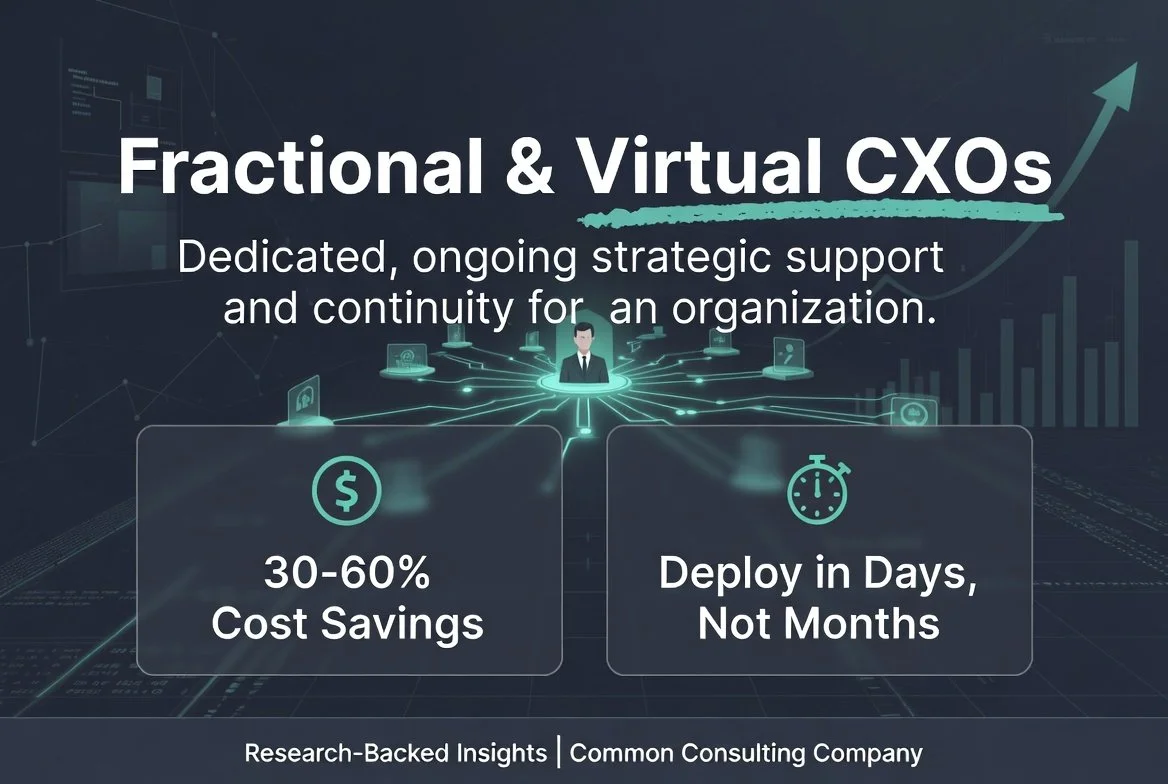
Industry analyses and practitioner reports consistently position fractional models as delivering 30–60% (or greater) savings relative to equivalent full-time capacity, while providing access to leaders with Fortune 500-caliber experience. This efficiency enables organizations to allocate resources toward execution rather than overhead, and it scales elegantly—engagements can expand or contract as needs evolve, unlike rigid full-time structures or scope-creep-prone projects.
Compared to pure outsourcing or project-based support, the dedicated nature reduces hidden coordination costs, rework from knowledge loss between vendors, and the premium often paid for transactional consulting without ongoing strategic ownership or deep integration.
Quantifiable Benefit #2: Accelerated Time-to-Impact and Operational Continuity
Speed represents another rigorously observable benefit. Vetted fractional and interim executives can typically be deployed and contributing within days to a few weeks—sometimes as quickly as 48 hours for urgent needs. This stands in stark contrast to the average executive search timeline of three to six months (or longer for specialized roles), followed by additional ramp-up time for cultural integration and context-building.
The implications are tangible:
Minimized leadership vacuums: Sudden departures, M&A activity, or scaling inflection points no longer stall strategic decision-making or expose the organization to heightened operational or security risks.
Immediate value realization: Leaders arrive with proven playbooks, cross-industry insights, and the authority to act decisively from the outset.
Predictable continuity: Engagements often span six months to multiple years, allowing for relationship-building and iterative progress rather than the start-stop nature of discrete projects.
Research and placement data underscore that this velocity preserves organizational momentum. In government contracting and regulated environments, where compliance deadlines or proposal responses demand swift expertise, the ability to onboard known, pre-cleared professionals quickly provides a decisive edge.
Project-based outsourcing, by comparison, frequently involves extended scoping, contracting, and team mobilization phases before meaningful work begins—delaying impact and introducing variability in team composition and quality.
Additional Strategic and Soft Benefits
Beyond the hard numbers, organizations consistently cite several qualitative advantages that compound the ROI:
Dedicated accountability and integration: A single, consistent executive presence creates trust, enables nuanced understanding of internal dynamics, politics, and history, and ensures recommendations are tailored and actionable—elements often diluted in multi-consultant project teams.
Knowledge transfer and capability uplift: Fractional leaders actively mentor internal teams, document processes, and build sustainable internal competencies, leaving the organization stronger long after any specific initiative concludes.
Fresh perspectives with low risk: Exposure to multiple organizational contexts equips these leaders with diverse best practices. The engagement model inherently lowers mis-hire risk, as fit can be validated in real time, with clear off-ramps or paths to full-time conversion if desired.
Strategic flexibility: Adjust focus areas, time allocation, or even pivot roles (e.g., from interim CIO to ongoing CDO support) without the friction of new vendor procurement or headcount changes.
Alignment with Common Consulting Company Experience
The patterns observed in broader market research closely mirror the outcomes we have facilitated through Common Consulting Company's Virtual CXO services. Whether stepping into interim CIO roles to sustain operations and support permanent searches during unexpected vacancies, providing ongoing part-time CISO leadership with compliance audits, remediation, and board-level reporting, guiding digital transformation strategies for manufacturers, or chairing architectural review processes for acquisitive firms—our clients have realized the cost discipline, rapid stabilization, and enduring strategic value that the data predicts. Our approach prioritizes embedding dedicated, pre-vetted professionals who function as true extensions of the leadership team, delivering the continuity and ownership that distinguishes this model from transactional outsourcing.
Conclusion
As adoption accelerates and the evidence base grows, virtual and fractional CXO engagements represent more than a tactical workaround for budget or headcount constraints. They offer a research-supported pathway to elite expertise, operational resilience, and financial prudence—particularly when continuity, integration, and dedicated partnership matter more than isolated project outputs. Organizations ready to move beyond conventional outsourcing models are finding that the quantified benefits in cost and speed, combined with the softer advantages of trust and capability building, create a compelling case for this evolved approach to leadership support.
Key Sources
MetaIntro Fractional Leadership Report (2026 data on market size, growth, CEO adoption intentions, and U.S. business penetration).
Industry placement and service analyses on fractional CIO pricing structures and compensation benchmarks (e.g., Bureau of Labor Statistics data referenced in executive services literature).
Practitioner and search firm insights on deployment timelines for interim versus permanent executive roles.
Market segmentation research highlighting interim and part-time C-suite shares and growth rates (DataIntelo Fractional Executive Services Report context).