
From Clay Tablets to AI Agents: The Evolution of the Business Order
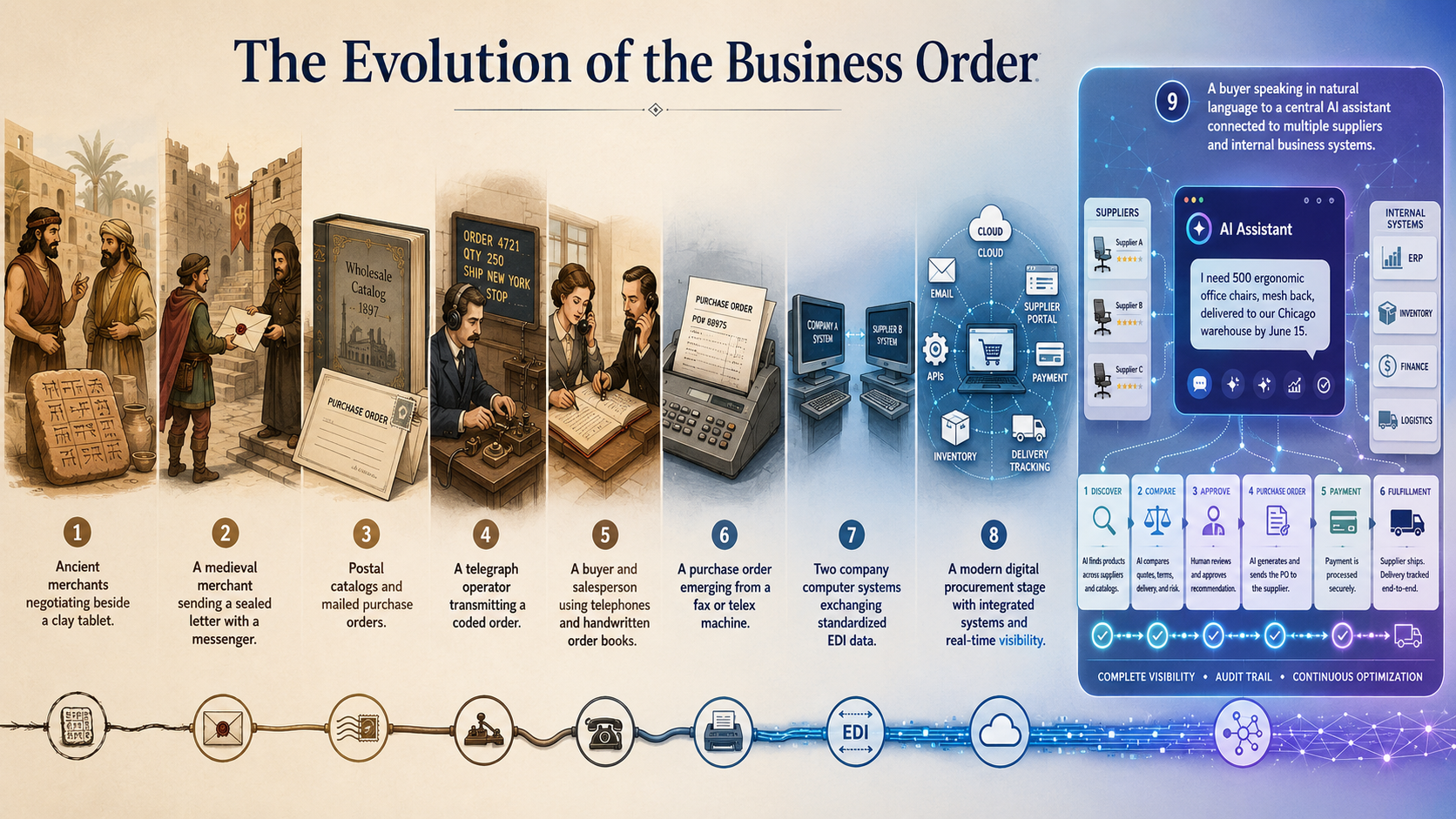
For thousands of years, placing an order between businesses required two people to communicate directly.
In ancient marketplaces, buyers and sellers negotiated face-to-face. Larger transactions might be recorded on clay tablets, papyrus, or tally sticks. As trade expanded, merchants began relying on handwritten letters, messengers, agents, and sealed contracts to conduct business across greater distances.
The development of reliable postal systems made written purchase orders practical. Businesses could mail requests, catalogs, price lists, and confirmations, but completing a transaction could still take days or weeks.
The telegraph changed that. An urgent order could suddenly travel between cities in minutes. The telephone made communication even more natural: a buyer could call a salesperson, discuss what was needed, and place the order directly. Behind the scenes, however, someone still had to write everything down and enter it into a ledger or accounting system.
Telex and fax machines made written orders nearly instantaneous. Buyers could transmit an actual purchase order rather than relying on a conversation, creating a clearer record of the transaction.
Then businesses began connecting their computer systems. Electronic Data Interchange, or EDI, allowed large companies to exchange standardized purchase orders, confirmations, invoices, and shipping notices automatically. Email later made digital ordering accessible to nearly everyone. However, spreadsheets, PDFs, and attachments often still required someone to re-enter the information.
E-commerce platforms, supplier portals, and procurement systems moved ordering online. Buyers could browse catalogs, check prices, submit orders, and route purchases for approval. APIs took this further by allowing systems to exchange pricing, inventory, payment, fulfillment, and shipping information in near real time.
Now we are entering the next stage: AI-assisted commerce.
Instead of navigating a website or manually assembling a purchase order, a buyer may simply describe what is needed. An AI assistant can identify suitable products, request quotes, create the order, coordinate approvals, and track delivery and fulfillment.
The business order has evolved from a conversation, to a document, to a transaction between systems. Its next form may be a conversation once again. Only this time, the conversation will be with an intelligent assistant capable of coordinating the entire process.
Are you forcing your customers to try to figure out the right way to tell you what they need? Are your sales people building relationships or manually typing in order data? Would consistently entered well-formed orders help you fulfillment staff?
Are you ready to explore an order entry solution that is easier for your customers, creates well formed orders for you back office and frees up your sales staff all at the same time?