
The Cost of Standing Still
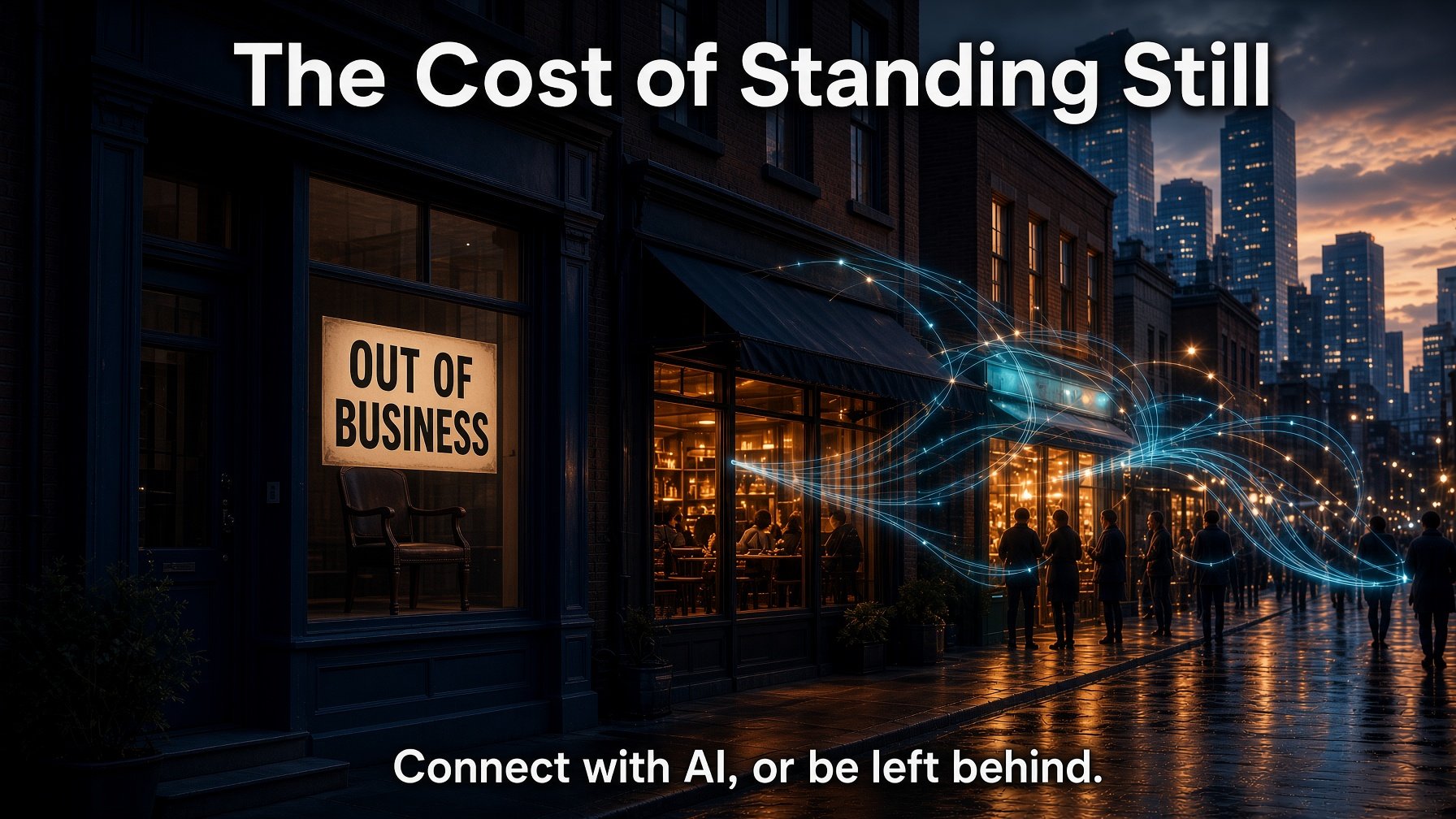
Standing still feels safe—until the customers quietly choose a different path.
Most organizations prefer the sales and distribution channels they already understand. The old ways still work. Changing systems feels risky and expensive. So the default posture becomes maintenance: keep the website updated, keep the app functional, keep the phone lines staffed, keep email flowing. History suggests that comfort is not free.
The Pattern That Keeps Repeating
Every major shift in how people exchange information and complete transactions has followed a similar script. The majority said the new method would never replace the old one, or would remain a niche. A smaller group treated the change as inevitable and prepared. When the volume finally moved, the prepared group owned disproportionate share. The rest spent years catching up—or never fully did.
The telephone was once dismissed as a novelty that would never threaten the telegraph. Early e-commerce was widely viewed as unsuitable for anything beyond books and low-consideration items. Mobile apps were, for a time, treated as optional extras rather than a primary way customers would choose to interact. In each case the consensus proved wrong, and the companies that waited paid for the delay in lost relationships, lost data, and lost momentum.
A new shift is underway. Customers are beginning to discover, compare, and complete purchases inside conversations with AI systems rather than by visiting websites or opening apps. The interaction itself is becoming the storefront. This is not a future scenario. Traffic and behavior data already show the front end of the migration.
The Numbers Are Moving
Adobe Analytics recorded AI-referred traffic to U.S. retail sites rising 693% year-over-year during the 2025 holiday season, with continued strong growth into 2026. In recent measurements, visitors arriving through these new paths have begun converting at higher rates than traffic from more traditional sources. Multiple consumer studies in 2026 find that a substantial and growing share of adults—commonly reported between roughly 40% and more than 70% depending on the exact question—have already used AI tools somewhere in their shopping journey. A meaningful cohort now starts product research on AI platforms rather than traditional search.
Forecasts for the commercial impact are substantial. McKinsey estimates that by 2030 agentic commerce could orchestrate up to $1 trillion in U.S. B2C retail revenue and $3 trillion to $5 trillion globally. Bain projects a U.S. market of $300–500 billion by the same year, representing 15–25% of e-commerce. Other analyses place agent-driven or agent-influenced share of online sales in similar double-digit ranges.
The practical reality is simple: when it becomes easier for a customer (or the software acting on their behalf) to complete a purchase or reorder with one business than another, volume follows the easier path. Relationships and reorder data follow the volume.
Large organizations with deep engineering resources are already connecting to this channel. Smaller and mid-market companies face a different calculation. Continuing to operate only through the older interfaces does not stop the shift. It simply means more of the new traffic will route elsewhere.
What Standing Still Actually Looks Like
Businesses move information, products, services, and decisions through systems. When those systems were designed for human visitors on a website or in an app, they often still work reasonably well for those paths. They are less ready for a world in which an external system needs reliable, real-time access to catalog data, availability, pricing rules, capacity, ordering, and status—and needs to complete the transaction without forcing a human into every step.
If parts of the operation still rely on processes that are essentially digital versions of pencil and paper—manual status checks, incomplete inventory visibility, order entry that requires a person—the new channel stays high-friction or closed. The customer’s preferred path of least resistance leads somewhere else.
This is not an argument for abandoning existing channels. It is an argument against treating the newest one as optional. The cost of standing still is not theoretical. It is the gradual migration of discovery, consideration, and transaction volume toward whoever made the interaction easier.
A Proactive Stance
Organizations that treated each new channel as inevitable and prepared while they still had time and margin consistently outperformed those that waited for overwhelming proof. The current shift is following the same arc, only faster. The practical response is neither panic nor indefinite observation: evaluate whether the flows of information, product, and service can support clean interaction through the emerging channel, and make deliberate upgrades where they cannot. The goal is to keep the path of least resistance aligned with your own offerings rather than someone else’s.
Companies that help organizations assess and modernize these flows exist for this reason. The work is less about chasing the newest tool and more about ensuring the business itself remains reachable and actionable as customer behavior continues to change.
Standing still has a price. The only question is whether you pay it later, under pressure, or invest now while the terms are still favorable.
Key Sources
McKinsey & Company. “The Agentic Commerce Opportunity: How AI Agents Are Ushering in a New Era for Consumers and Merchants.” October 2025. https://www.mckinsey.com/capabilities/quantumblack/our-insights/the-agentic-commerce-opportunity-how-ai-agents-are-ushering-in-a-new-era-for-consumers-and-merchants
Bain & Company. “2030 Forecast: How Agentic AI Will Reshape US Retail.” December 2025. https://www.bain.com/insights/2030-forecast-how-agentic-ai-will-reshape-us-retail-snap-chart/
Morgan Stanley Research. “Here Come the Shopping Bots” (agentic shopper projections of $190–385 billion in U.S. e-commerce by 2030). December 2025. Reported in Digital Commerce 360: https://www.digitalcommerce360.com/2025/12/09/morgan-stanley-ai-agentic-shoppers-385-billion-online-sales/
Adobe. “Holiday Shopping Season Drove a Record $257.8 Billion Online with Consumers Embracing Generative AI Tools.” Adobe Digital Insights / Adobe Analytics, January 2026. (AI-referred traffic to U.S. retail sites +693.4% YoY for Nov–Dec 2025.) https://news.adobe.com/news/downloads/pdfs/2026/01/010726-holiday-shopping-season-2025.pdf See also: https://business.adobe.com/blog/ai-driven-traffic-surges-across-industries
Adobe Digital Insights. Additional reporting on AI-referred traffic growth into 2026 and conversion performance of AI-sourced visitors.
Consumer adoption surveys (2025–2026) on AI use in shopping journeys, including findings from Exploding Topics, Product.ai, ICSC/McKinsey, IBM-NRF, L.E.K. Consulting, and others (reported adoption ranging from roughly 40% to more than 70% depending on definition and timeframe).