
Why You Can't Find Good People and Why Re-Designing the Work Might Be the Answer
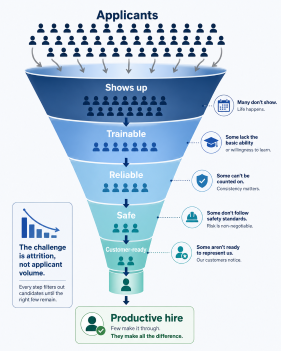
Business owners and operators keep saying some version of the same thing: “I can’t find good people.” Not just engineers, licensed electricians, plumbers, mechanics, carpenters, and technicians, but also laborers, cleaners, installers, and entry-level workers who show up, learn, work safely, deal with customers, and avoid creating rework.

For a long time, many businesses did not think of labor as a system they had to build. Good people seemed to come through familiar channels: family connections, local schools, unions, apprenticeships, word of mouth, and workers who learned by starting at the bottom and staying long enough to move up. If someone retired, someone younger was usually close enough behind them to step in. That informal pipeline was never perfect, but it often worked well enough that businesses could treat hiring as a recurring task, not a strategic constraint. Today, that is no longer the case, and the cost of a bad hire has become too high to ignore.

The frustrating part is that this persists despite businesses raising wages, calling temp agencies, asking around, and interviewing candidates. The problem is not always a lack of applicants. It is a lack of people who are ready, reliable, trainable, and worth trusting on a real job site, in front of a client, in a customer’s home, or in a role where mistakes are expensive.

The data backs up what CEOs and managers are feeling. In June 2026, NFIB reported that 32% of business owners had job openings they could not fill, including 27% with skilled-worker openings and 12% with unskilled-labor openings. Construction alone needs an estimated 349,000 net new workers in 2026 to meet demand, according to Associated Builders and Contractors. And in skilled trades such as electrical work, the challenge is not just growth. BLS projects about 81,000 electrician openings per year, many due to workers retiring or leaving the occupation.

Business owners and managers have been left carrying a problem the broader labor pipeline has stopped solving for them. Skilled workers are no longer being churned out through mentorships and apprenticeships at a pace that can keep up with retirements. Rebuilding this talent pipeline will take time, time you don't have.

If the market is no longer reliably producing ready-made workers, then the business has to become better at turning imperfect labor into productive labor. That starts by making the work easier to teach, easier to repeat, easier to supervise, and easier to improve.
Start Re-designing the Work
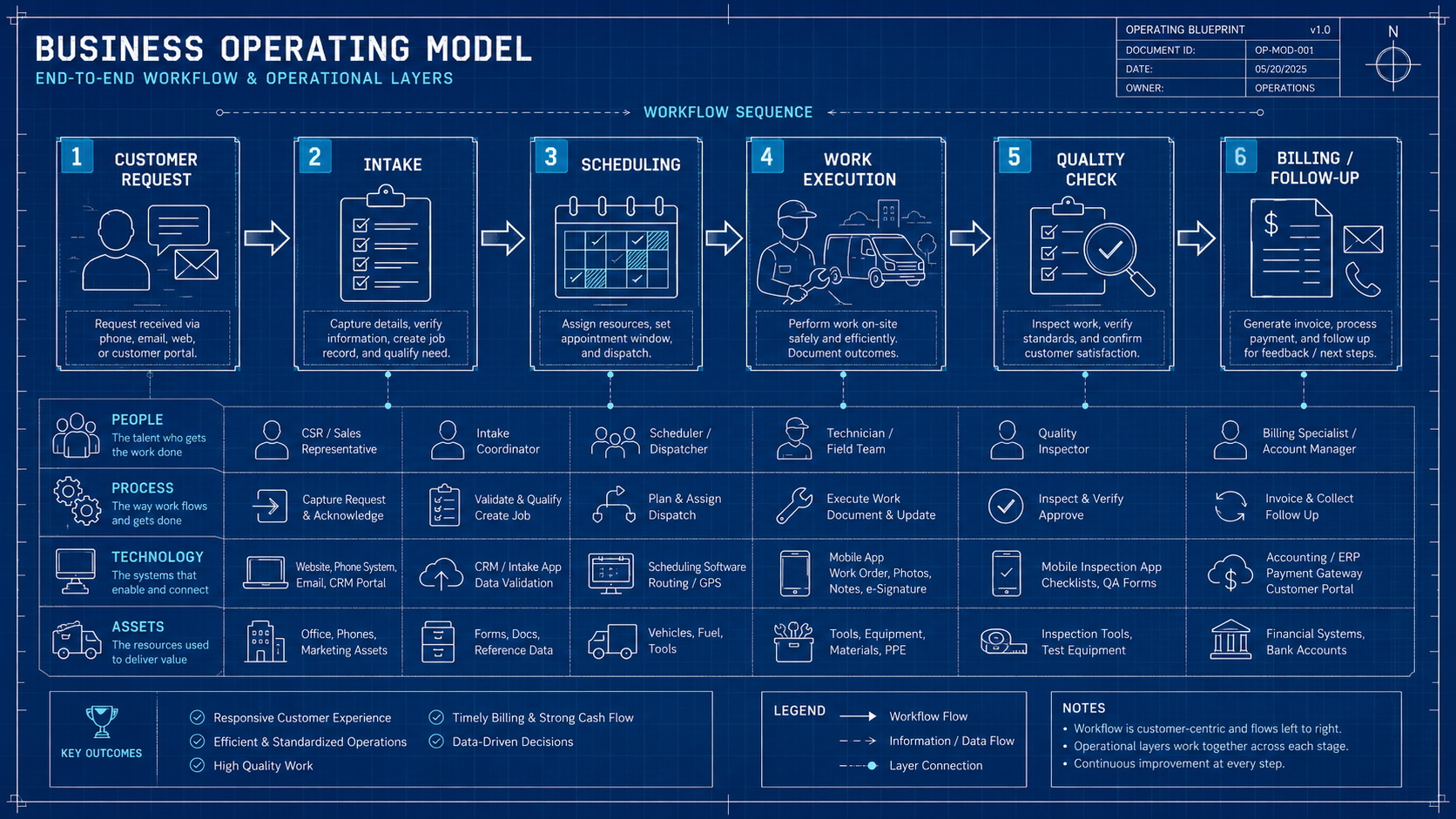
Understanding the architecture your business has evolved into will help you design for the challenges you face today.
Most managers and CEOs are too busy running the business to step back and see how the work actually flows. But without that picture, every labor problem looks like a hiring problem. Sometimes it is. Other times, the real issue is unclear roles, inconsistent processes, poor onboarding, wasted skilled labor, or work that could be shifted to tools, templates, or lower-cost support roles.

The first step is getting a clear understanding of your business architecture. Business Architecture is a structured view of how a business creates value: what capabilities it needs, how work flows across people and processes, what roles and assets are involved, and how those pieces connect to deliver outcomes.

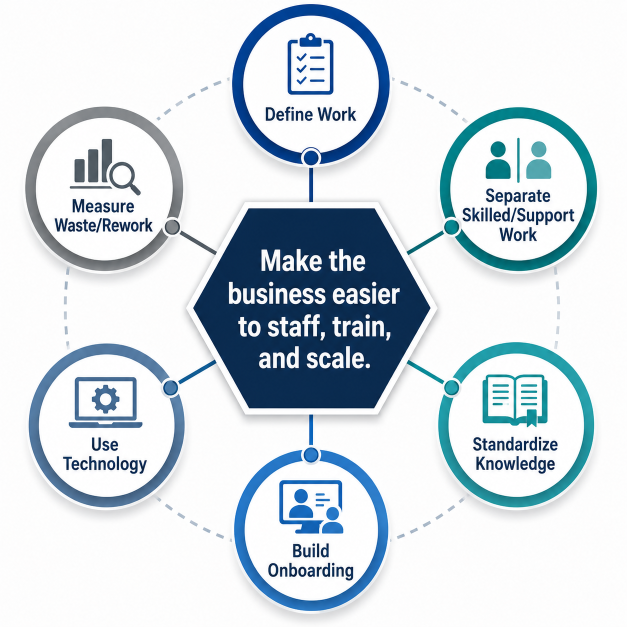
With this, you can design how you want the work to get done, taking into account not just today's challenges but the advancements as well. You can:
Define the actual work, not just the job titles, so you resource appropriately or creatively if needed.Separate skilled work from support work so your most valuable resources do the most valuable work.Turn tribal knowledge into repeatable checklists, standards, and training steps so people are effective immediately.Build onboarding for turnover instead of pretending it will disappear, simply de-risk it.Use technology and process improvements to protect scarce skilled labor.Measure waste and rework and use the dividends to hire better people or upskill who you have.
When was the last time you stepped out of your business and looked inside it? Are you comfortable painting that picture yourself? How would you do it? What if it could be done for you? We've partnered with companies of all sizes to solve problems just like these, because we want to get your Fridays back. Want to learn more?